
Hit enter to search or ESC to close
Trending Now

Lens choice often matters more than the camera body itself when it comes to real estate photography. A great lens captures full rooms accurately, keeps lines straight, and handles the tricky lighting that interiors throw at it. This guide walks through what to look for in a lens for property photography and which types work best for different shooting situations.
Why Lens Choice Matters So Much
Real estate photos need to show a room's true size and layout without distortion. A poor lens can make rooms look warped, cramped, or oddly proportioned, which hurts a listing's first impression. Since buyers judge properties quickly online, lens quality directly shapes how professional and trustworthy a listing photo feels.
Key Lens Features for Real Estate Work
Focal Length
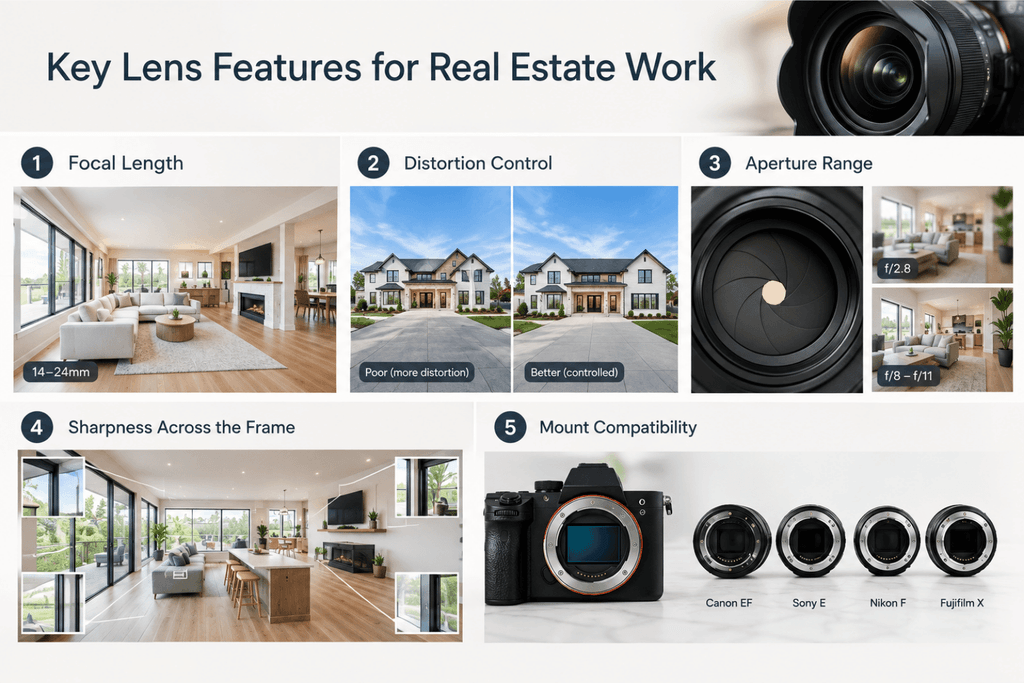
Most real estate photographers rely on wide-angle lenses, typically between 14mm and 24mm on a full-frame camera. This range captures enough of a room to show its full layout without pushing walls into extreme, unnatural distortion. Going wider than 14mm often introduces noticeable barrel distortion, which can make straight walls look curved.
Distortion Control
Wide-angle optics naturally introduce some distortion, but higher-quality glass controls it far better than cheaper alternatives. Look for options specifically designed to minimize barrel and pincushion distortion, since heavy distortion requires extra correction work in post-production and can still look unnatural even after editing.
Aperture Range
A wide-open aperture of f/2.8 or wider offers more flexibility in dim interiors, though real estate photographers often shoot at narrower settings like f/8 to f/11 anyway, to keep both foreground and background sharp. Still, that extra flexibility helps when shooting handheld or in low light.
Sharpness Across the Frame
Corner sharpness matters more in real estate photography than in many other genres, since wide shots often place important details — like windows, doorways, or architectural features — near the edges of the frame. Glass that stays sharp from center to corner produces far more usable, professional-looking images.
Mount Compatibility
Before buying new glass, confirm it matches your camera's mount system. Many manufacturers now produce versions of the same optic for multiple mounts, so double-check compatibility with your specific camera body, especially if you've switched brands or systems recently.
Popular Lens Types for Real Estate Photography
Wide-Angle Zooms
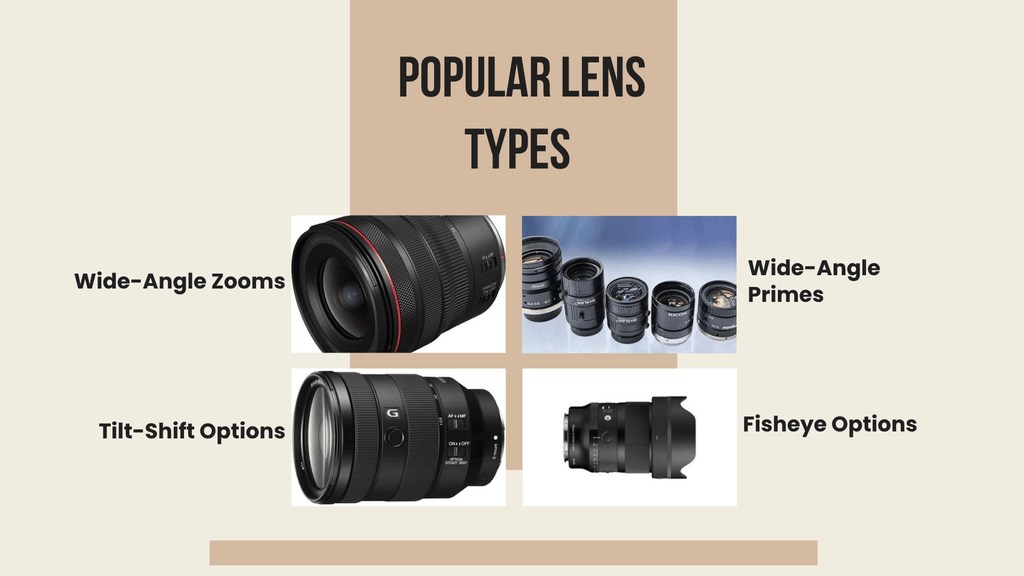
Zoom options in the 14-24mm or 16-35mm range offer flexibility across different room sizes without needing to switch glass mid-shoot. This versatility makes zooms a popular choice for photographers who shoot varied properties, from small condos to sprawling homes.
Wide-Angle Primes
Prime optics, which have a fixed focal length, often deliver sharper results and better distortion control than zooms at a similar price point. A 16mm or 20mm prime is a common choice among real estate photographers who prioritize image quality over flexibility.
Tilt-Shift Options
Tilt-shift optics let photographers correct perspective distortion directly in-camera, particularly useful for keeping vertical lines straight when shooting upwards in tall rooms. These tend to be expensive and require more manual technique, so they're most common among experienced photographers working on high-end listings.
Fisheye Options
Some photographers use fisheye glass for extremely tight spaces, though the resulting curved distortion needs correction in editing software afterward. This option works best as a specialty tool for usually small rooms, rather than a primary choice for most shoots.
Matching Your Optic to Your Camera System
Optical performance depends heavily on your camera's sensor size. Glass marketed as "24mm equivalent" behaves differently on a crop-sensor camera than on a full-frame body, since crop sensors effectively narrow the field of view. Always check the actual angle of view a given focal length produces on your specific camera before assuming it will capture a full room.
Budget Considerations
Prices vary widely based on brand, build quality, and aperture range. Entry-level wide-angle zoom options often start around $400 to $700, while professional-grade wide-angle zooms with wider apertures can run $1,200 to $2,000. Tilt-shift optics typically cost even more, often exceeding $1,800, due to their specialized mechanics.
For most real estate photographers, a mid-range wide-angle zoom offers the best balance of image quality, flexibility, and cost. Upgrading from a kit lens to dedicated wide-angle glass usually improves photo quality more noticeably than upgrading the camera body itself.
Conclusion
Choosing the right lens for real estate photography comes down to balancing focal length, distortion control, and sharpness against your budget and shooting style. Quality wide-angle zoom glass covers most everyday listing needs, while tilt-shift optics serve photographers working on premium properties where perspective accuracy matters most. Ultimately, investing in good glass often delivers a bigger improvement in image quality than upgrading the camera body alone.
Read more:
Best Camera for Real Estate Photography: A Buyer's Guide
Day-to-Dusk Real Estate Editing vs. Twilight Photography Explained
Photorealistic 3D Rendering for Real Estate: Marketing Tips